

Our second day in Vienna and it’s a sunny one. Perfect for exploring the city at our own pace, walking.
I forgot to note down the #steps we did that day.
But if you start the day at Margareten, walk to Belevedere 21 & Belvedere Schloss, continue to Hundertwasserhaus and follow the Donau canal-Wienfluss with a lunch break at Plachutta Wollzeile, enjoy the view of Domkirche St. Stephan, next Peterskirch, Hofburg and Marie-Theresien-Platz with a quick stop at Wiener Secession, a drink at Naschmarkt and continue on Rechte Wienzeile to our hotel, this means more daily steps than what is prescribed by the World Health Organisation.

The Belvedere 21 is the antidote to Vienna’s exuberant Baroque architecture. A timeless building with contemporary art.
It was designed by Karl Schwanzer for the 1958 World’s Fair in Brussels. After the fair, the Australian pavilion was dismantled and rebuilt in Vienna. In 1962, the building began its second life as a museum of contemporary art.
During our visit, two artists were exhibiting their work.
Born is 1959 in Eisenstadt/Austria, Maria Hahnenkamp is an autoditact photographer and graphic designer. She applies various techniques to her photographs. Images are sanded down and stitched together with patterns to create new ones.
Born in 1969 in Leicester/Great Brittain, Jonathan Monk is a contemporary conceptual artist.
He has printed images from previous installations in Berlin, Montreal, Tel Aviv and Copenhagen on a 35-metre-long curtain. In this way, he creates a sense of an open ending.


The Upper Belvedere sits on a hilltop offering a magnificent view over Vienna. Built in 1721-1722 for Prince Eugene. After the assassination of Franz Ferdinand and the collapse of the Habsburg Monarchy, the Belvedere Palace was nationalised in 1919 and left to the Staatsgalerie who transformed it to one of the first public museums in the world. The entrance with its majestic white marble staircase is beautiful, as is the marble hall with its magnificent ceiling painting by Carlo Carlone.
We went to see Gustav Klimt, but of course there was much more to see.



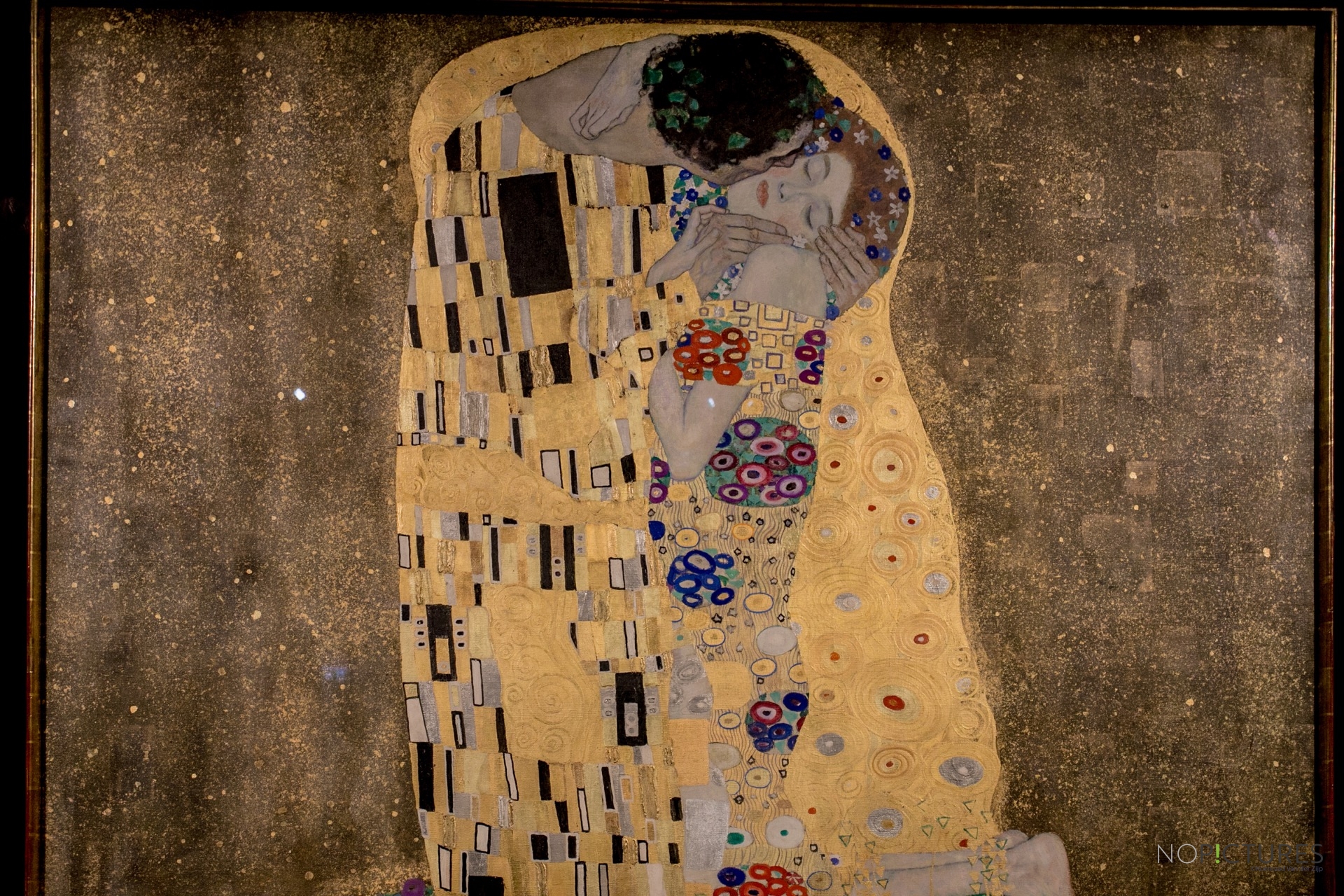


Next we’re heading to see Hundertwasser Haus and Kunst Haus Wien.
Both organic buildings sprouted from the creative mind of Friedensreich Hundertwasser. In addition to being an artist and architect, he was also an environmental activist. Architecture meets art. For him, sustainability was not a trend, but a philosophy.
He does not like repetitive window arrangements, as they remind him of prisons. He prefers them to be placed in a criss-cross pattern. From the initial design stage, attention must also be paid to include natural elements.
His use of mosaics and bright colours is somewhat reminiscent of Antoni Gaudi.
Unfortunately, we did not have enough time to go inside. That will have to wait until our next visit to Vienna.


Art must show its true colours again. Art must address the people again.
Art must embrace nature and her laws and man and his striving for true and lasting values-Friedensreich Hundertwasser-

The Domkirche St. Stephan is simply beautiful. It was not built in one go.
It underwent several renovations, extensions and mandatory refurbishments after a number of fires.
The stained glass windows in the church are magnificent and temper the light softly.
The altar piece, made of black Polish marble, depicts the stoning of St. Stephen.


